Part 2 of a series on procuring onsite energy from a place of control. Part 1 covered knowing what to buy before you go to market. This one covers how to run the market.
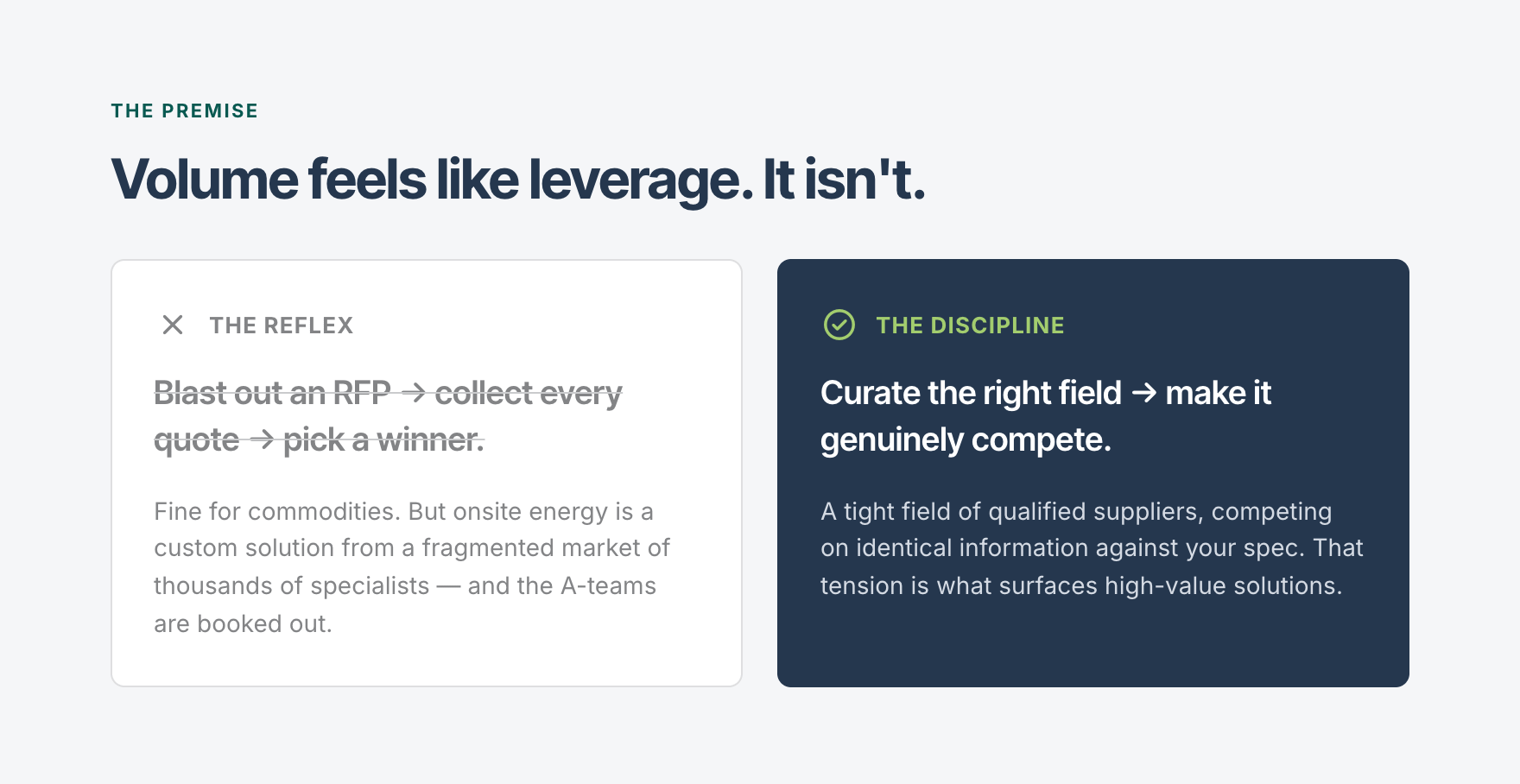
When most people think about running a “competitive process,” they think this means volume, blasting out a generic RFP to a broad swath of the market, collecting quotes, and then picking a winner.
I have seen this in the business world throughout my career and it doesn’t work, it creates so much wastage on all sides of the market. It potentially works for commodities, but onsite energy is not a commodity. It is a custom solution delivered by a fragmented market. The market is made up of thousands of regional and local specialists, each with their own areas of expertise (size, technology types, self-perform, outsource, commercial models….) and the A teams are booked out. So how do you get their attention and partner for the best possible outcomes for your business?
The game is not casting the widest net, it is curating the right field, then making that field genuinely compete.
Curate before they compete
In Part 1 we determined that best practices are defining what you are buying. Now you decide who earns the right to bid and how you curate the right field. Five primary filters matter:
Geography and local experience. Permitting, labor laws, incentives and interconnection rules differ everywhere. Screen for recent projects in your region and evidence of standing relationships with your utility. A supplier who knows your jurisdiction keeps your project on schedule with no change orders (beyond the unexpected).
Size and technology fit. A contractor who has built a career on 250 kW rooftop arrays may be out of their depth on solar plus storage plus backup generation for a cold storage facility. Look for experience within about 30 percent of your target size and the same technology mix.
Financing fluency. Your partner must speak the same language as your CFO. If you want a PPA or energy as a service structure, ask for sample term sheets and financier references early. If they cannot deliver the structure, the price does not matter.
Safety, quality, and uptime. Review OSHA metrics and insurance requirements, then go further. Talk to past clients. Did projects finish on time, on budget, without incidents? A supplier with a sloppy safety culture usually has deeper operational cracks.
Actual capacity. The best firms juggle multiple large projects competing for the same crews and components. Ask about their pipeline and their construction windows. A partner honest about bandwidth beats one that overpromises to win the bid.
Then curate, three bidders minimum, three to six is optimal. Enough to create tension, few enough to manage efficiently and to signal to every bidder that they have a real shot as they are competing on merit against quality competition, not cowboys. This is exactly what motivates them to put their best foot forward and deliver high-value solutions.
Run a tight, transparent window
Open the bidding window for three to four weeks for most projects. This is long enough for thoughtful proposals and short enough to maintain momentum. If your project is overly complex, extend this window accordingly.
It is best practice to host a structured Q&A where every bidder sees the same answers at the same time. No side conversations and no back channels. Schedule a single site visit; motivated suppliers want to see the property, electrical infrastructure and roof for themselves, and it makes their pricing sharper.
Here is why this structure pays you back in hard dollars. A developer’s cost of sale can run well over $100,000 per project: marketing costs, months of business development chasing opportunities that mostly go nowhere, “free consultations” and proposal costs. Those sunk costs do not disappear, they get baked into the price of every project that does move forward. Every successful project in this industry carries the weight of multiple failed pursuits. I recall in a past role, when I was a part of a pursuit for a large LNG operations project in Western Australia, we spent >$500,000 on the proposal and lost. As buyers asking people to commit time and resources to proposing, we need to really respect this notion and understand that our approach to procurment has consequences on not only our outcomes, but the entire market.
A curated, well-run process strips that waste out and creates compounding benefits for the whole market. Suppliers get a qualified, data-rich opportunity that matches their expertise, and they price it accordingly. This is a big part of why projects run through a disciplined process consistently come in 20 to 50% lower in price and with better outcomes, than traditional approaches. You are not squeezing suppliers, you are removing the inefficiency they would otherwise have to charge you for.
Evaluate on value, not sticker price
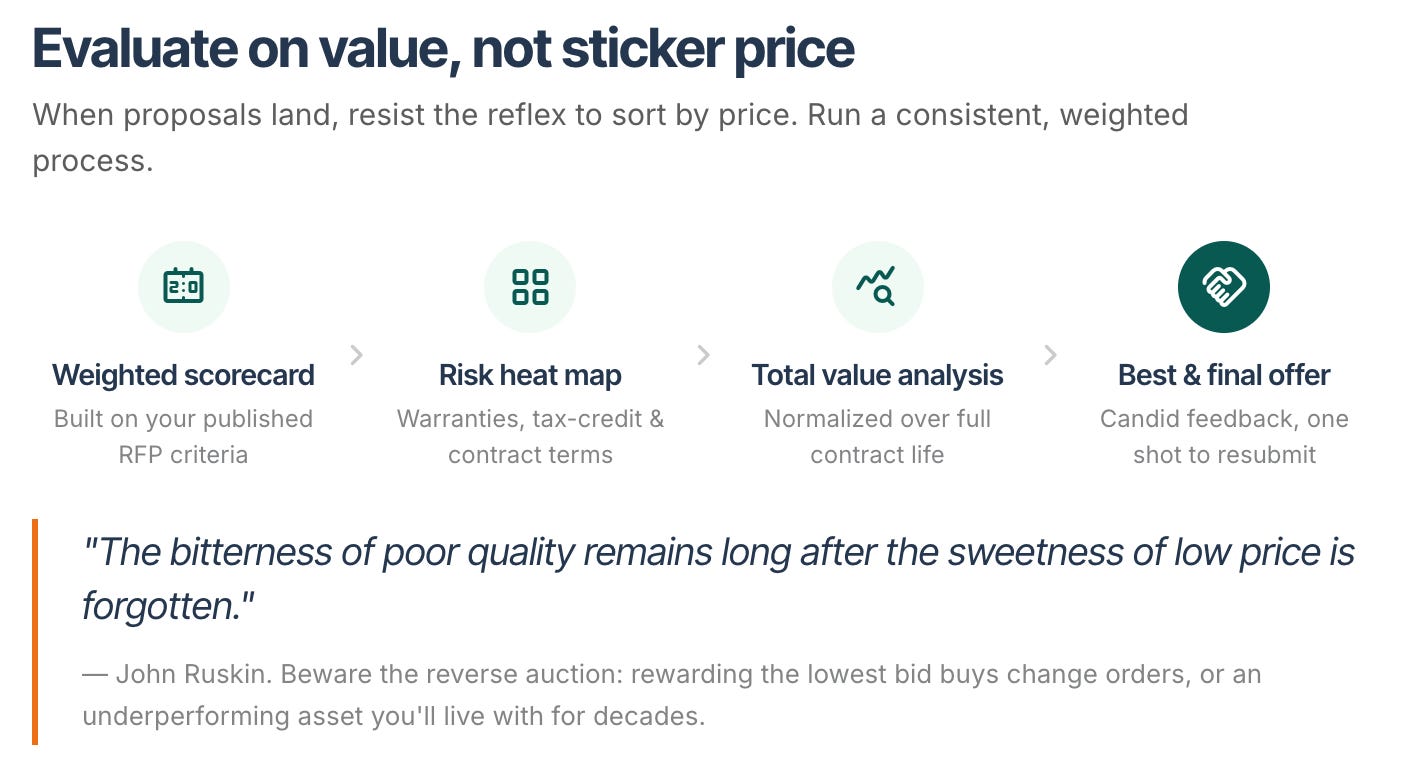
When proposals land, resist the reflex to sort by price.
Use a scorecard built on the criteria you published in the RFP, weighted and applied consistently. Build a risk heat map; equipment, warranties, interconnection assumptions, tax credit compliance, contract terms. Then run a total value analysis, normalizing every bid over the full contract life, including escalators, maintenance, and performance guarantees.
The cheapest option can often hide expensive exclusions. As John Ruskin put it, “the bitterness of poor quality remains long after the sweetness of low price is forgotten”. But if all else is equal, cost is very important. Be wary of any process built like a reverse auction or getting you quotes without this curated analysis - which is common when there is minimal upfront dilligence as there is no other way to compare and contrast. Rewarding the lowest bid in this format is how you create countless change orders, or worse yet, buy an underperforming asset you will live with for decades.
Finish with a best and final offer round for your two or three finalists. Share candid feedback on where each excelled and fell short, and give them one shot to resubmit. Negotiate on lifecycle economics, total cost of ownership, availability guarantees, degradation rates, and O&M response times, not the headline number.
What this looks like in practice
A 120-year-old food distributor ran this exact process for a new cold chain facility in Florida. Tight construction timeline, a 2 MW utility cap, shifting federal tax credit rules, tariff uncertainty, and strict insurance requirements. They compressed the journey from opportunity analysis to signed contract into two quarters, received competitive bids 20% below market benchmarks, and locked in a right-sized 1.8 MW rooftop system projected to save $5 million over its life.
Their director of construction told me the process let them take ownership at every step and make quick, well-informed decisions even while the market changed around them. That is what control feels like.
And the timeline claim is not marketing. Run deliberately, this playbook compresses what used to be six to eighteen-month procurement cycles into four to twelve weeks. Preparation creates speed, and speed matters, because incentive programs run out of money and interconnection queues fill up while committees deliberate.
Done wrong and you end up confused, overwhelmed, bombarded by quotes that you can not compare or contrast, misaligned suppliers, cost decisions vs value outcomes and an investment you lack confidence in and struggle to get internal support for.
The takeaway
Curation beats volume and structure beats instinct. A tight field of the right suppliers, competing on identical information against your specification, is how you buy a twenty-five-year asset that will deliver and exceed your expectations.
Next week, Part 3: the three well-worn paths that feel like progress- the consultant, the open marketplace, and the developer already in your lobby- and why each one quietly costs you control.
The full step-by-step playbook, from supplier vetting through contract and commissioning, is Chapter 8 of Powering Profits.