Why Energy Cost Predictability Matters More Than Price For Your CFO
Cheap Power Rates and Expensive Lessons

I met a CFO recently who told me something that resonated:
“I’m not as worried about baseline rising energy costs. I’m more worried about energy cost predictability.”
His company operates large manufacturing facilities, and on paper, it has some of the lowest power rates in the country. However, when business is good and production ramps up, their energy demand spikes. With these spikes, rates rise three to four times higher than the baseline.
It’s as if each time the company’s energy demand exceeds its pre-agreed peak demand threshold with the utility, the business is punished for doing well. A good month of production can become a bad month on the profit and loss statement, and budgets that looked watertight suddenly leaked six figures. He routinely misses forecasts by $100,000 to $250,000 per month, not due to poor business decisions, but because of volatility embedded in his utility contract. He tried to re-negotiate the peak demand limit (set based on estimates from past operations) for his facilities, but the utility would not consider it.
The Hidden Fragility of “Stable” Power
We often discuss energy risk as if commodity prices are the main culprit. But for most businesses, the real risk hides in the structure of their power supply and associated rate structure. Fixed contracts, time-of-use rates, and peak demand charges all work until they don’t. A tariff designed based on incorrect projections or historic operational norms can become a liability when production scales or shifts.
That’s the paradox of the current centralized energy strategy: it gives the illusion of control while quietly amplifying exposure.
The Hidden Cost of Success: Understanding Peak Demand Charges
Utilities charge for total consumption (kilowatt-hours) and for peak demand, in the form of demand charges, which are the budget killer on your utility bills. Demand charges can make up between 30% and 70% of a facility’s monthly spend. The charges are based on your single highest 15- to 60-minute power spike in a billing cycle. In effect, one 15-minute surge can cost more than every other kilowatt-hour you purchase that month.
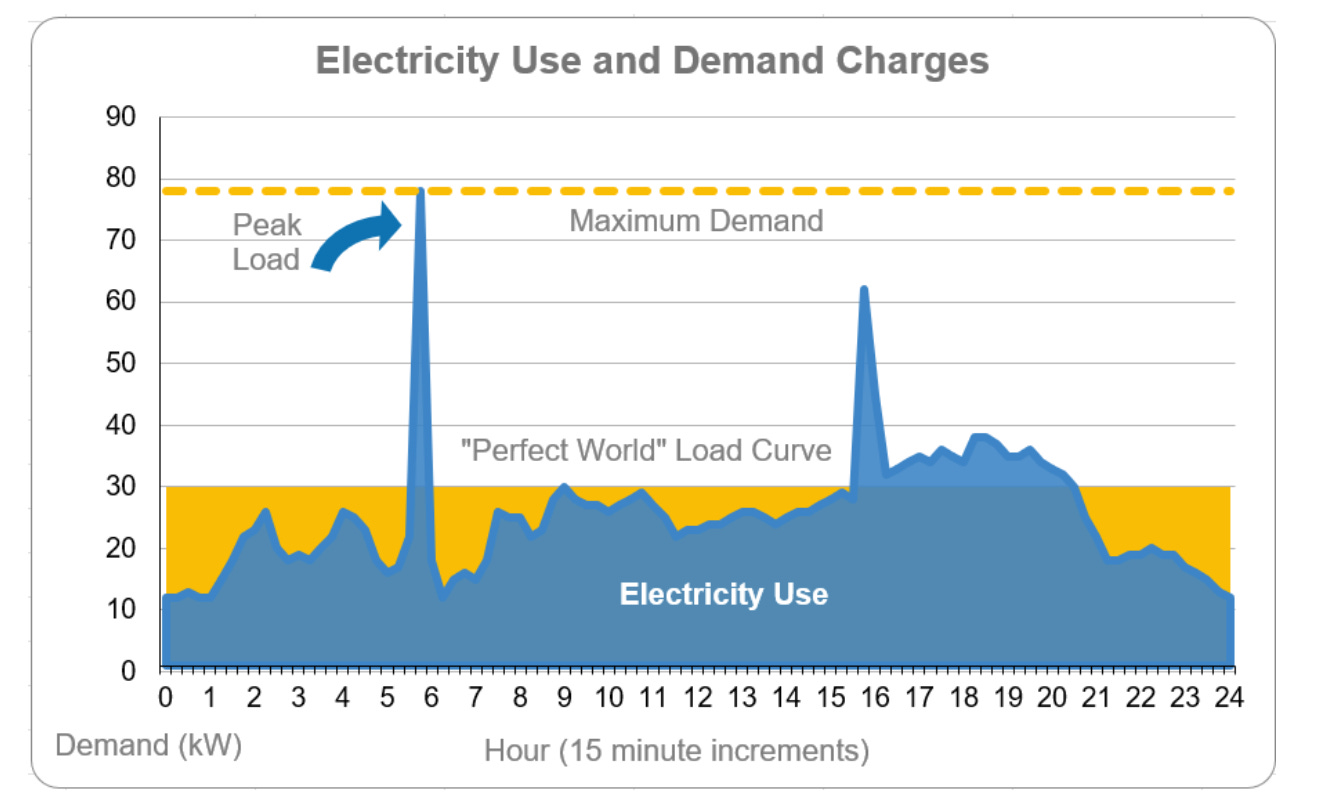
To determine the demand charge for a given month, the maximum power demand is multiplied by the demand charge rate. The exact billing approach varies by utility. Some rate structures include multiple types of demand charges with higher charges during hours of peak demand and lower charges during “partial-peak” or “off-peak” hours.
Pull out a recent electric invoice and you’ll usually see two big line items: one labeled “Energy,” charged in cents per kilowatt-hour and another labeled “Demand” or “Maximum kW,” charged in dollars per kilowatt. Many businesses discover, to their surprise, that they pay more for that one spiky interval than for all the rest of their energy combined.
Why does the utility bill this way? Grid infrastructure, generation, transmission, and distribution must be sized to accommodate the single highest energy demand scenario across all customers. In other words, as if every customer were consuming the most energy they possibly could, all at the same time. The RMI and Brattle Group estimate that the top 100 load hours (approximately 1% of a year) account for up to one-fifth of system costs.
The capacity sits idle most of the time, but because it is expensive to build and maintain, investors expect a return. Typical gas “peaker” plants operate less than 10% of the time, yet customers pay for them year-round. They are also less efficient and more emissions-intensive.
The CFO I met wasn’t being overcharged; he was being charged by design. And because these peaks are unpredictable without serious and continuous projection, they wreak havoc on financial models.
Summary: Peak Demand Charges
Peak Demand Charges = Y kW of demand * X $/kW
They can represent 30-70% of a facility’s electricity costs and are triggered even if the spike occurs only once.Why they matter: A single surge can significantly impact your monthly costs and compromise budget accuracy.
How to manage them:
• Adjust operations to be more energy efficient and strategically run energy-intensive processes in coordinated ways to minimize peak demand spikes.
• Use onsite energy generation solutions (solar, wind, gas, fuel cells, etc) to meet part of your load during peak windows.
• Add batteries to discharge power and reduce peak demand requirements.
How CFOs Can Manage Demand Charge Volatility
Managing peak demand starts with visibility. Most companies don’t track their energy use in real time, so they only see the damage after it hits and the utility bill is received. For CFOs, that’s like steering by looking in the rear-view mirror. Here is how you can get on top of your peak demand prices:
Step 1: Understand Your Load Profile
Every facility has a unique consumption fingerprint. By reviewing interval data (typically in 15-minute increments), CFOs can see when peaks occur and which processes drive them. This visibility reveals where to shift loads, reschedule operations, or reprogram equipment to flatten spikes before they become costly.
Often, those spikes happen during equipment start-up. When all the electric motors, deep fryers, conveyors, or packaging lines power up simultaneously, they draw a short but intense burst of electricity before settling into steady-state operation. Staggering start-ups, installing variable-speed drives on large motors, or sequencing process equipment through simple control logic are low-cost, high-impact ways to reduce peaks and restore predictability without new infrastructure.
Step 2: Improve Energy Efficiency
The cheapest kilowatt is the one you never use. Before tackling tariffs or adding technology, CFOs should ensure their facilities are operating efficiently. Efficiency can start with no capital cost operations refinements, training improvements and fine-tuning process controls, through to upgrading motors, optimizing HVAC systems, electrifying equipment or capturing waste heat to generate energy. All reduce the base load, meaning fewer and lower peaks. Learn more here - The Immense Savings Potential of Energy Efficiency
Step 3: Align Operations and Contracts with Tariffs
Start by understanding the tariff you’re on. Most businesses inherit rate structures that no longer match their operations. Review how your utility defines “peak demand,” how long those periods last, and whether there are seasonal or time-of-use variations.
If you’re developing a new facility or renegotiating a contract, agree to a peak demand threshold that aligns with your business realities, not arbitrary utility assumptions. Setting the wrong threshold can lock in years of unnecessary penalties. This is often limited to industrial sites and commercial customers typically have to select a tariff from a menu, but you should understand the structure of the agreement regardless.
Once you know the rules of the tariff game, adjust how and when you play. Utilities design rates around system stress, so running non-critical loads in off-peak windows can yield major savings. Many manufacturers can cut demand charges simply by rescheduling shifts or optimizing production cycles.
Step 4: Add Flexibility at the Edge
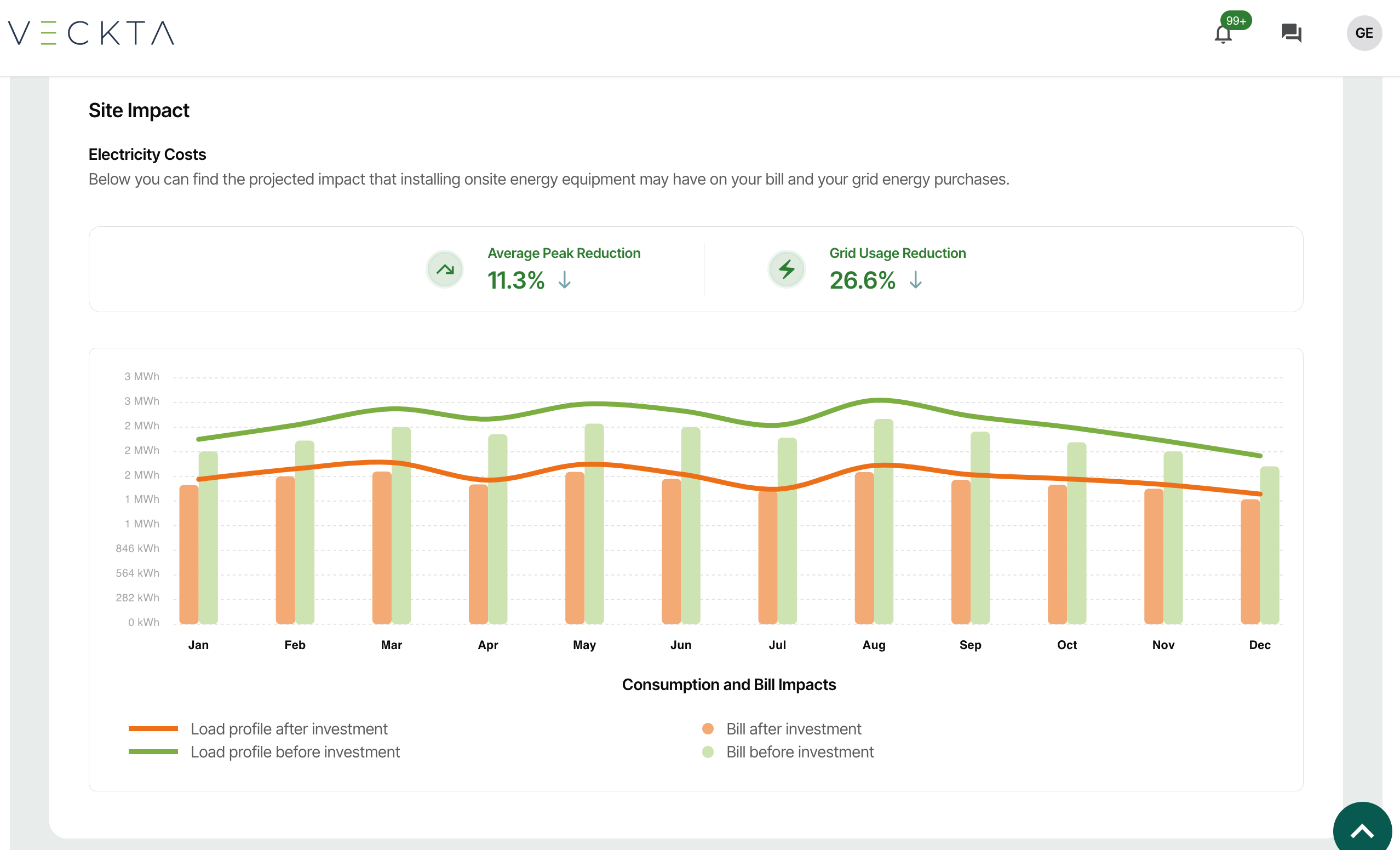
Technologies like battery storage and onsite generation provide the agility to “self-supply” during peak windows. Even limited flexibility, supplying a small fraction of your load from onsite assets, can dramatically reduce peak charges and increase resilience.
Something we come across with demand charges is that “solar alone won’t save you” with demand charges. If your peak demand happens when solar production is low or it is cloudy and raining, the offset you might expect from solar alone may not happen. Get it wrong one time in your peak demand measurement period (monthly/annual is typical) and you end up paying for it every day. This is where batteries are extrmely valuable.
Additionally, if you get ahead of this and invest in onsite energy assets, there are further ways to monetize them and access a new revenue source, such as, participating in demand response programs. This is where you are paid to dispatch your onsite energy asset or curtail consumption.
Step 5: Build Energy into Financial Strategy
Energy volatility isn’t just an operational issue; it’s a financial one. Integrating demand forecasting into corporate models allows CFOs to treat energy like any other risk exposure. Budgeting for best, base, and worst-case demand scenarios turns volatility into a manageable, quantifiable factor.
Step 6: Revisit Contracts & Operations Proactively
Energy contracts are often written for a snapshot in time. As production expands or schedules shift, those contracts can become outdated and punitive. Regularly reviewing your tariff class, demand thresholds, and capacity clauses ensures your agreements evolve with your business, not against it. If there is a lack of flexibility to negotiate with your utility, the key is to constantly evolve and assess the return on investment tradeoffs of additional energy efficiency and onsite energy investments. You also want to truly understand how to play the energy game to ensure you are buying utility power when it is at its most affordable, particularly as rates escalate and time-of-use and peak demand charges become more prevalent and costly.
Predictability Is the New Profitability
For CFOs, energy predictability isn’t just a technical goal; it’s a financial imperative. If your energy costs can triple or more in unanticipated ways, you can’t forecast accurately or scale confidently.
Predictability protects margins, safeguards investment, and builds resilience. It’s the bridge between operational excellence and financial performance.
The CFO I met didn’t need cheaper rates. He needed predictable energy costs.
And that starts with control.